
My entire podcast and distribution plan, now, later, and tomorrow
This is one of those weekend posts where I sat with my recent recording disaster long enough that it pushed me into a final pivot, and I ended up with a real plan for the year.
Read also: Mac app paused, recalibration, and content: update #12
First, I cut out what I don't want right now: a traditional podcast with guests or interviews. There are plenty of those already, so that's completely off the table. But I do feel I finally found my place in content creation, and that was the largest hurdle
It doesn't rule out more YouTube content in a different format down the line, or even live streaming my room while I build stuff, which honestly doesn't sound like a bad idea. But that's a long way off.
Where things stand
I know I've already been a bit of a maniac about this, but apparently I'm also completely unhinged when it comes to adding more. Before you call me fucking crazy, there's a lot of structure underneath the chaos.
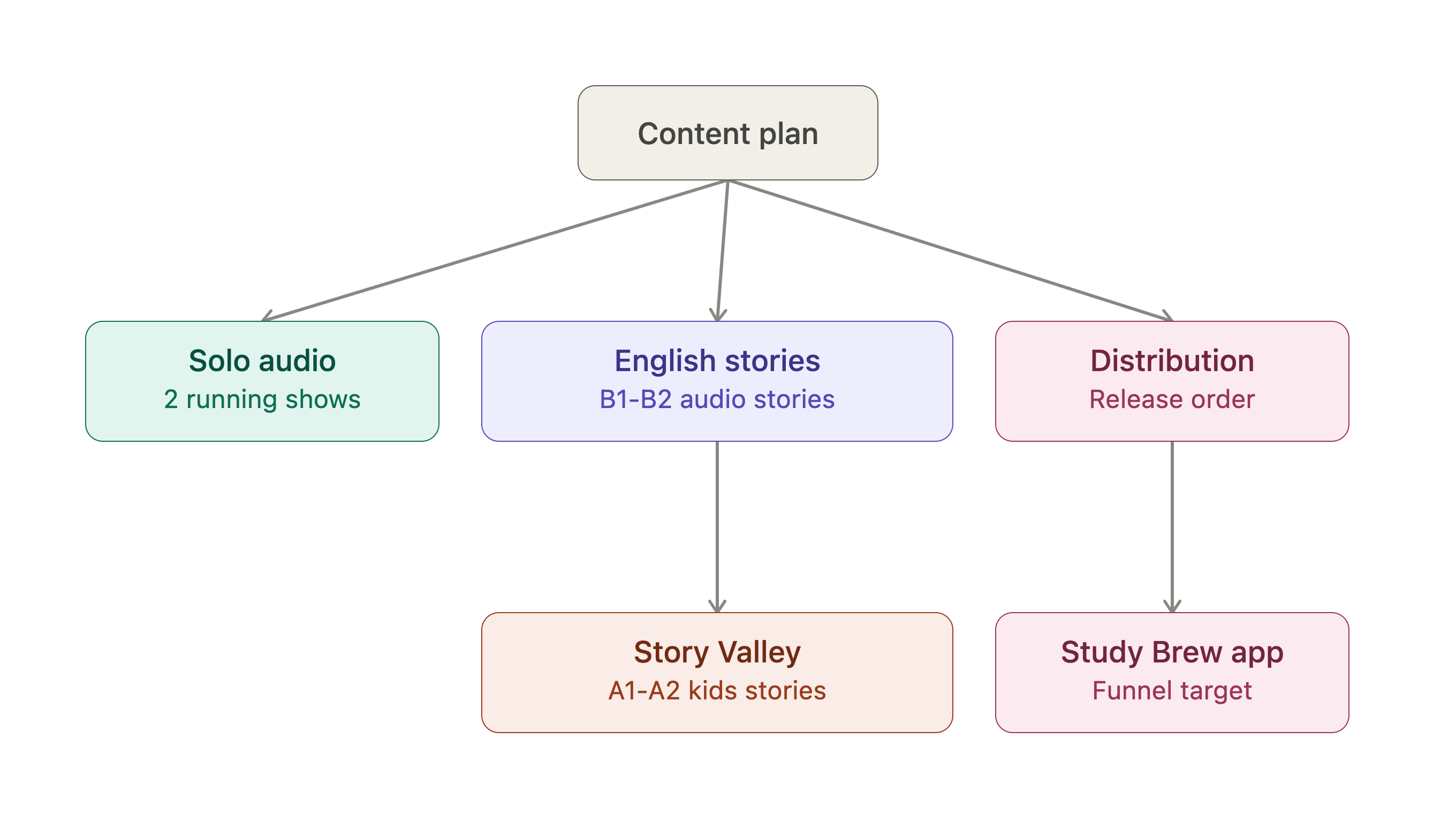
I want to be a full content creator across different formats, and up until now that's mapped out into four things:
Echo Room is my unfiltered weekly monologue, one topic a week. Then there's my personal audio journal.
Story Brew is bedtime stories for B1-B2 English learners, and Study Brew covers the same B1-B2 level in a different form. I kept Story Brew as it was, and wrote a whole separate post about that decision.
Read also: My game plan for Study Brew: I almost blew it
That list is already big, and every piece of it made sense to me. Story Brew and Study Brew are almost the same thing, just running on two different channels.
Both exist for the same reason: to funnel people toward the note-taking language app I'm building for English learners.
Echo Room sits on its own island, and my personal audio journal works as an extension of what I already write here. Everything has a clear job.
But I'm going one layer deeper.
Story Valley
For most of my life, I wanted to build an iPad app for kids, something interactive for children with ADD or ADHD. I probably can't build that now, but the idea never really left me.
This weekend it hit me that I want to try a new audio channel: short English stories for A1-A2 kids, three to four minutes each, very short and simple sentences.
I started digging into it and wrote a few examples, and it turns out I could realistically record fifty of those in a single day if I wanted to, enough to fill an entire year on autopilot.
I'm calling the format Story Valley, and the first character is Sara, six years old, short brown hair, lives with her mom and dad, has a small garden, and asks "what is this?" every time she runs into something new.
Fears
This is unknown territory for me. Walking into the parenting and children's content space with English stories, as a non-native speaker, could be genuinely hard. I'm not there to teach anyone. I just want to record and hope a few parents find it useful.
I asked Gemini for advice, since that's become my go-to for strategy, and it told me recording stories for A1-A2 level kids is a solid idea, as long as I align the approach with how language acquisition works for young learners and busy parents.
I agree with that, and it made me a little more comfortable with the whole thing.
It also pointed out that at the A1-A2 level, clarity, steady pacing, and warm delivery matter far more than having a native accent, and that children and early learners benefit a lot from clear, accessible pronunciation.
I can get behind that too, even if it adds a bit of pressure. I'm not intimidated yet.
It flagged that this is a high-demand segment, since simple, slow, accessible English audio for early learners gets searched constantly by non-native parents who want passive English exposure for their kids but don't feel confident reading aloud themselves.
That part stuck with me, because it's true. Parents want the best for their kids, and even when they don't speak English themselves, they know how much it matters, and they'll look for whatever tools might turn their kid into a bilingual genius.
The catch, according to Gemini, is that if my pronunciation or flow isn't solid, I risk not measuring up, or worse, teaching early learners the wrong patterns. But I can flip that around too.
My accent can be an asset. A lot of non-native parents feel intimidated by native media, and hearing a non-native speaker deliver fluent, clear English can make the whole thing feel more achievable for the entire family.
By that logic, I can eventually funnel some of those parents toward Study Brew, and maybe they'll feel more motivated to learn English themselves with the right tools, since the Study Brew app isn't built for kids.
Read also: Study Brew: planning, deconstructing, and thinking ahead
I'm still working out if this all holds together, but I think it does. Recording short, simple English stories and eventually funneling parents toward an app feels like it closes a loop for me between podcasting, recording, and building.
Whether the logic holds is still to be seen, but I want to at least try it. I don't need to hit every channel at once. I'll start with Spotify, then YouTube. Pinterest will become a massive driver eventually, once there's enough content, because intent on Pinterest is almost always to buy or learn something.
Read also: Pinterest strategy: I finally figured out my content plan
Impact
The first thing I asked myself was how much this costs me, and honestly, not that much. It's low friction once I build a proper cheat sheet for the recording process, start to finish. It stops being a burden and starts being something closer to a joy.
The plan looks solid on paper. What happens in a week is anyone's guess, especially coming off a week that was mostly frustration and failed recordings.
Time estimates
If I guess how much work goes into a single episode across each channel, including distribution on Spotify and YouTube, plus thumbnails and avatars, it looks roughly like this:
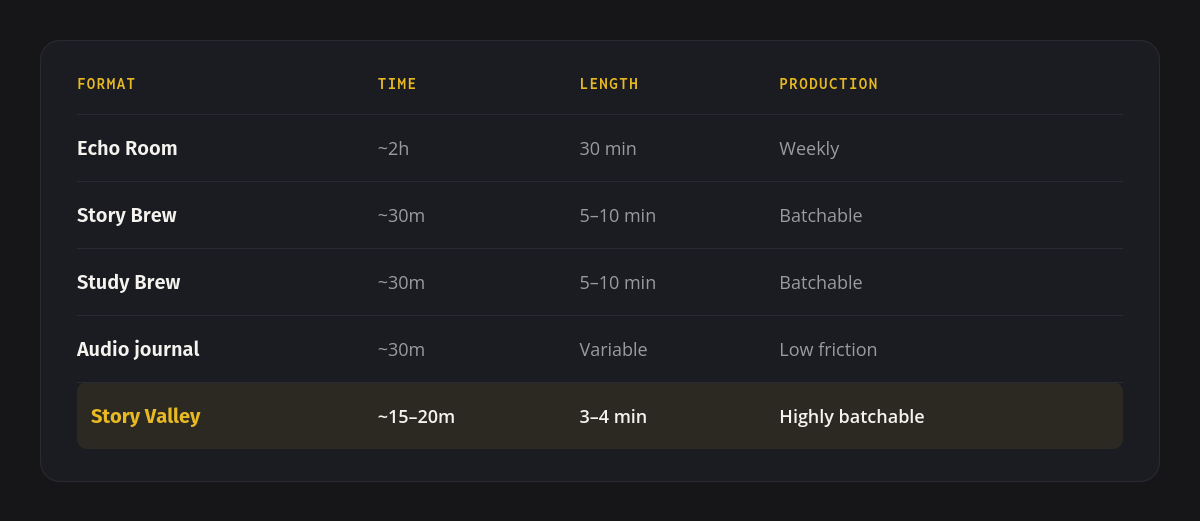
Echo Room takes about two hours for a thirty-minute episode, since I need a few bullet points before I record it freely, and there's no editing because it's unfiltered.
Story Brew and Study Brew each take about thirty minutes per story, and most stories run five to ten minutes.
My personal audio journal takes about thirty minutes per entry too, since it's just as low friction.
Story Valley is the outlier: fifteen to twenty minutes of work for a story that only ends up being three to four minutes long, since I'm still figuring out the format.
Final word
I don't think I'm crazy for doing this. Most of what I've listed can be batched or recorded in bulk in a single afternoon.
It helps me balance building and writing with something that's evergreen and educational, and gives me something to feel good about beyond just shipping code.
Get new posts before anyone else
No noise, no automation sequences. Just what I'm writing, thinking about, and building, sent when there's something worth sending.
An email once in a while. Unsubscribe anytime.

Written by
Pieter Borremans
Writer·Content creator·Founder
Based in Taichung, Taiwan and London, UK, this is Pieter's personal journal and builder's blog: field notes on entrepreneurship, solo business-building, and the unfiltered reality of creating online. Alongside it, he's chasing one absurd goal in public, $168M USD in lifetime earnings, tracked live from zero.